Aristide Gattavecchia
Scultore e Pittore
2023 - interview with Leonarda Zappulla
For information and contact details for Aristide Gattavecchia, sculptor and painter, visit the website or write directly to:
www.gattavecchia.it
www.gattavecchia.eu
email: aristide@gattavecchia.it

Sculptor and Painter
Italian artist of the 1900s

.png "artboxy)")
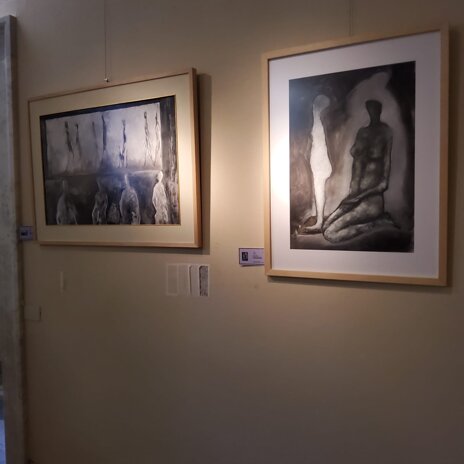
Commented works

During various exhibitions, some of Gattavecchia's works have been the subject of critical analysis aimed at promoting greater understanding on the part of the observer of the techniques used and the themes addressed.
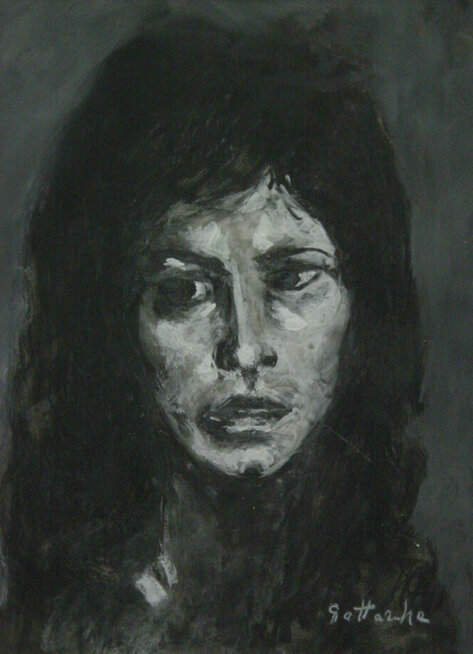
La Bruna - 1960
charcoal on cardboard 16x12 inches
The artist was able to leave us very important signs of his human relationships in works such as this one, which is a remarkable portrait of great power.
Prof. Vittorio Sgarbi
Here too, although physiognomic elements return to identify the subject, the sense of introspection always prevails in the complex brushstrokes, in the accentuated synthesis, in the insistence on monochrome.
A strong feeling pervades this face that avoids the gaze, as if it did not want to show its inner suffering.
Translated with DeepL.com (free version)
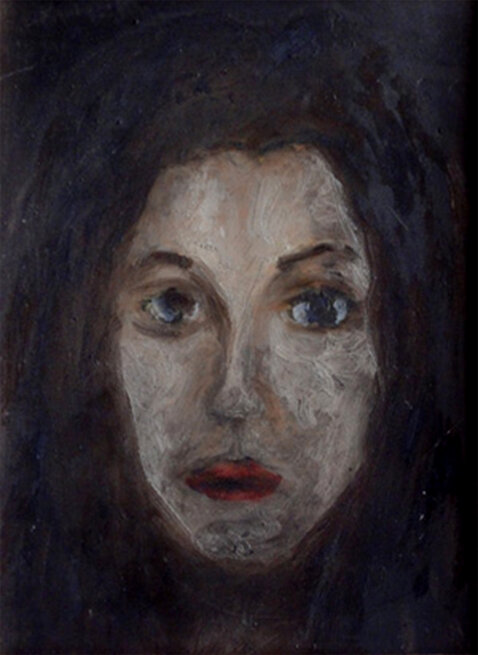
La Bruna 80 - 1980
mixed media on plastic 9.45 x 11.81 inches
"Gattavecchia lived through the wars and profound crises that shook the 20th century, a century in which the individualism of artists reached its peak.
His works tell of violence, fear, loneliness, incommunicability, and marginalization.
In the style of Munch, the woman emerges from the darkness, marked by diaphanous light and with a resigned gaze into the void: yet those red, full lips do not hide her beauty and passion."
Prof. Vittorio Sgarbi
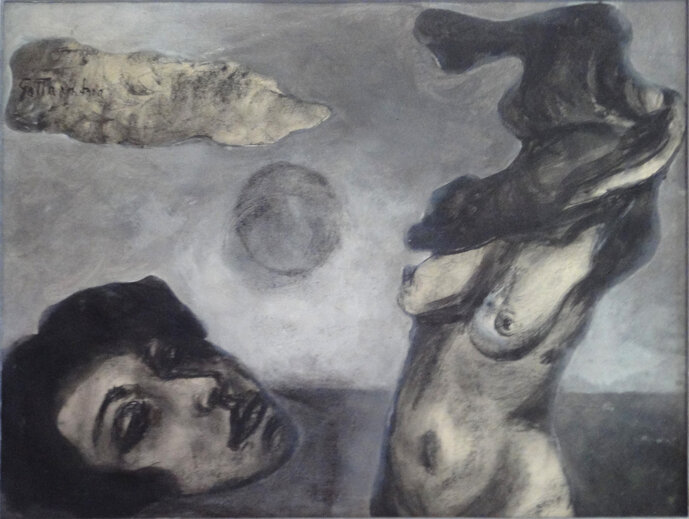
Frammentazione
1968
mixed media on cardboard 33x17.7 inches
In a gray world where clouds look like stones, a vibrant body is depicted with a black cloak in place of its head.
Although detached from the body, the head appears dreamy and relaxed.
The surrealism of this work takes us into a dreamlike dimension where every part of us can be fragmented and live a life of its own.
Body and mind often travel on two distinct planes, sometimes irreconcilable.
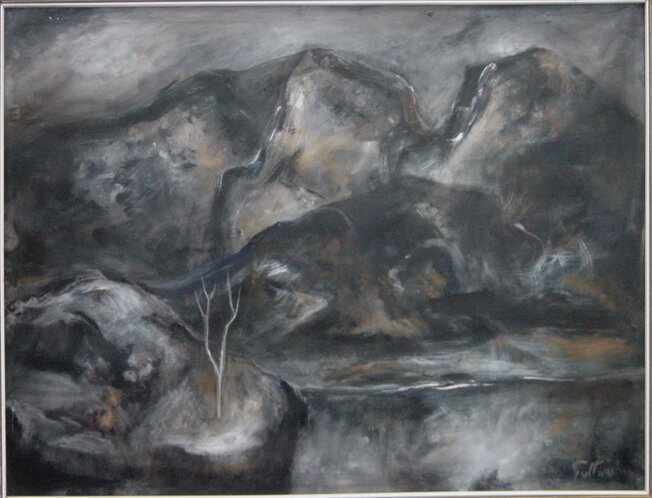
L’Albero bianco - 1992
mixed media on fabric 29.5 x 37.4 inches
The theme of ecology and the environment often recurs in Gattavecchia's art.
As early as 1971, in his work “Tempi moderni I” (Modern Times I), he denounced the problem of waste abandoned in open dumps.
But in this 1992 painting entitled “L'albero bianco” (The White Tree), he goes further.
He depicts a desolate landscape without life or people, only a slender, bare white tree. It looks like the result of an apocalyptic event that has wiped out everything and left only unlikely remnants of life.
Nature is devastated, only rocks without life remain.
But that white tree represents hope, a slender thread of existence from which to start again.
The artist's message, starting from a pessimistic vision, leads us to reflect on our behaviors that could still correct and heal our future.
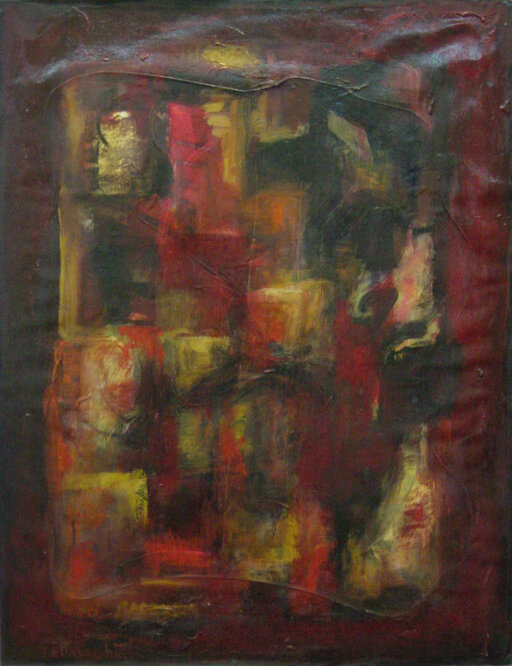
Frammenti VI - 1979
mixed media on plastic 25.6 x 18.9 inches
In 1979, Gattavecchia produced a series of six paintings entitled “Frammenti” (Fragments).
These are coherent works that share a common idea, that of the decomposition of the perception of content.
The realizations and chromatic variations make them similar but never identical.
Bright colors dominate, although the effect of black as a background is powerful; some parts are cut and reattached using the collage technique, through a process of research and symbolic reconstruction.
In all his works, Gattavecchia seeks to identify the intimate essence of the person; nothing is left to chance, the message is profound.
We are a mix of emotions, impressions, turmoil, and sensations.
All this completes our self, in an undefined complex that contains our entire inner life, the intimate essence of the human being.
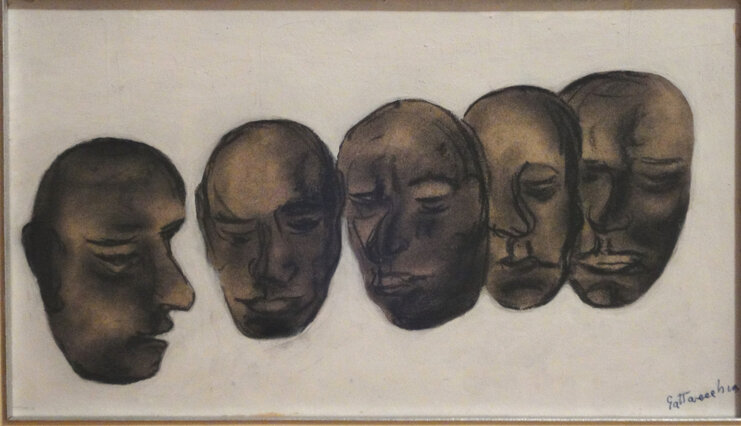
Indifferenza - 1979
mixed media on cardboard 9.45 x 16.9 inches
"Five male faces created using only brown colors stand out against a monochromatic background. Four are closer and only one, almost like a background figure, is shown in profile, with his mouth slightly open.
The choice to depict half-closed eyes is striking, in an explicit desire not to create empathy or suggest a relationship with the viewer outside the canvas.
The lack of communication and indifference also exists between the five characters: they are close, but each is closed in on themselves, in their own silent selfishness.
Presented with extreme formal stylization and typified as if they were masks, these faces become symbols of the alienation and isolation that grips contemporary society.
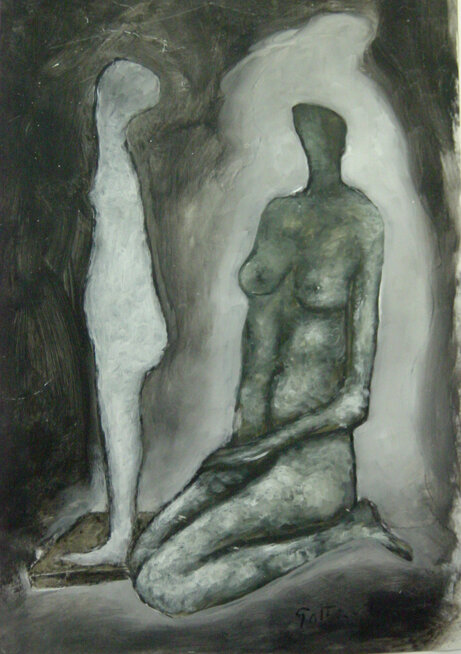
Introspezione - 1984
tempera on plastic 25.6 x 17.7
In his 1984 work “Introspezione” (Introspection), Gattavecchia explores the theme of inner analysis, achieved through meditation and the pursuit of self-awareness.
In the painting, the female subject is depicted sitting on her legs, relaxed, almost in a prayerful attitude.
It is a state of mental calm that allows one to listen to one's inner voice, to recognize thoughts, emotions, and needs.
Behind her appears a glow that illuminates her, emphasizing the moment of understanding her emotions, while in front of her stands a figure representing her most intimate inner self facing a black horizon that she has yet to confront.
The search for answers is part of all our experiences and is a distressing situation that we have all experienced.
The artist manages to convey the intimacy and loneliness of such a special and profound moment.
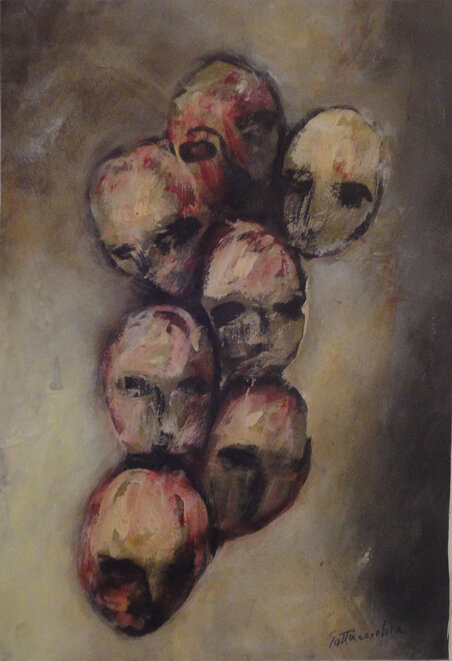
Pensieri II - 1948
tempera on cardboard 18.1 x 12.6 inches
Seven mask-like faces are depicted, clinging to one another, suspended in time. No mouths are visible, only black eyes, which make them resemble skulls.
The red color that “smears” them reminds us of the horrors of war.
It was 1948, and the suffering of the past was still vivid and painful.
The artist expresses his deep anguish of existence.
The thoughts that crowd the mind are like lifeless heads, floating in a surreal dimension that is nothing more than pure subconsciousness.